
Probiotic and Sleep Quality: What the Gut Has to Do
Gut Health and Sleep Quality
Poor sleep has become a defining health issue of modern, urban life. In Malaysia, studies point to widespread sleep difficulties, not just among working adults, but also among university students [1, 2].
The usual response is to reach for a supplement or a sleep aid. But a newer body of research suggests the real lever might be somewhere less obvious: your gut [3, 4].
The Gut–Brain Axis and Sleep
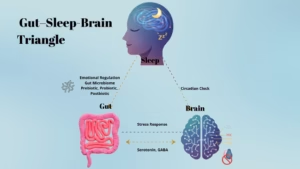
Most of us think of probiotics purely in terms of digestion. What’s less well known is that the gut and the central nervous system are in constant two-way communication through what’s called the gut–brain axis [3, 4]. Through this network, gut microbes can influence brain function, and the brain can influence gut function right back; shaping everything from how we handle stress to how we regulate emotion [3].
Probiotics, the beneficial live microorganisms we consume, work, in part, by tapping into this axis [4]. That’s the idea behind psychobiotics: specific probiotic strains that, when taken, may support both emotional well-being and, potentially, sleep quality [4, 5].
How Probiotics (Psychobiotics) May Support Sleep
Psychobiotics aren’t sedatives—they won’t knock you out the way a sleeping pill might. Instead, they appear to work indirectly, targeting two of the biggest underlying drivers of poor sleep: stress and mood.
Here’s what the proposed mechanisms look like.
1. Supporting Neurotransmitter Production
As much as 90% of the body’s serotonin—the precursor to the sleep hormone melatonin—is produced in the gut [6].
Certain strains, particularly within the Lactobacillus and Bifidobacterium families, have been shown to support GABA synthesis [7, 8]. Higher GABA activity is associated with relaxation and calm, both of which set the stage for better rest [7].
2. Rebalancing the Microbiome and Easing Stress Signals
Elevated cortisol, the body’s primary stress hormone, is a well-known disruptor of sleep. Research suggests probiotics can help rebalance the microbiome and reinforce gut barrier integrity, which in turn may help regulate stress signaling and reduce nighttime waking [5].
What the Research Actually Shows
A 2024 meta-analysis published in Clinical Nutrition ESPEN, reviewing 15 randomized controlled trials, found that probiotic supplementation significantly lowered Pittsburgh Sleep Quality Index (PSQI) scores compared to placebo at both 4–6 weeks and 8–16 weeks, indicating improved sleep quality [9].
A few strains stand out in the clinical literature:
- Bifidobacterium breve CCFM1025 — A 2023 randomized clinical trial found this strain improved sleep quality in adults, an effect linked to its role in regulating the activity of the HPA axis [10].
- Lactobacillus plantarum DR7 — A 2020 study found 12 weeks of DR7 supplementation reduced stress and anxiety in stressed adults, alongside changes in gut microbiota linked to the serotonin and dopamine pathways. The study didn’t directly measure sleep quality, but its stress-reducing effects are consistent with better rest [11].
- Multi-strain Lactobacillus consortium — A 2025 proof-of-concept study of an elite-athlete-derived, multi-strain Lactobacillus probiotic found a 69% improvement in self-reported sleep quality in the general population, alongside gains in energy levels and bowel regularity [12].
Choosing a Probiotic for Sleep
If you’re evaluating a probiotic for sleep support, look for products built around documented probiotic strains, such as
- Lactobacillus plantarum (e.g., DR7, FB0015)
- Bifidobacterium breve (e.g., CCFM1025)
- Targeted multi-strain formulas with meaningful doses of Lactobacillus or Bifidobacterium
The Bottom Line
Probiotics offer a drug-free, evidence-informed way to support better sleep—particularly for people whose sleep issues are tied to stress or emotional imbalance [9].
They’re unlikely to dramatically extend total sleep time or act as a sedative. But the clinical evidence points to something more sustainable: feeling genuinely more rested, by way of a healthier gut–brain axis and a steadier stress response.
Disclaimer: This information is for educational purposes only and should not replace advice from your doctor or healthcare professional. Please consult a qualified provider before making changes to your diet or health regimen.
References
- Lakshme, S. V., Sharranesh, R., Yong Khang, Y., & Arvinder-Singh, H. S. (2025). Sleep quality, sleep hygiene practices and their influencing factors among Malaysian university students: A cross-sectional study. Malaysian Family Physician, 20, 22. https://doi.org/10.51866/oa.717
- Chan, C. M. H., Siau, C. S., Wong, J. E., Wee, L. H., Jamil, N. A., & Hoe, V. C. W. (2021). Prevalence of insufficient sleep and its associated factors among working adults in Malaysia. Nature and Science of Sleep, 13, 1109–1116. https://doi.org/10.2147/NSS.S295537
- Appleton, J. (2018). The gut-brain axis: Influence of microbiota on mood and mental health. Integrative Medicine (Encinitas, Calif.), 17(4), 28–32. https://pmc.ncbi.nlm.nih.gov/articles/PMC6469458/
- Johns Hopkins Medicine. (n.d.). The brain-gut connection. https://www.hopkinsmedicine.org/health/wellness-and-prevention/the-brain-gut-connection
- Ansari, F., Neshat, M., Pourjafar, H., Jafari, S. M., Samakkhah, S. A., & Mirzakhani, E. (2023). The role of probiotics and prebiotics in modulating the gut-brain axis. Frontiers in Nutrition, 10, 1173660. https://doi.org/10.3389/fnut.2023.1173660
- Bektaş, A., Erdal, H., Ulusoy, M., & Uzbay, I. T. (2020). Does serotonin in the intestines make you happy? The Turkish Journal of Gastroenterology, 31(10), 721–723. https://doi.org/10.5152/tjg.2020.19554
- Iorizzo, M., Paventi, G., & Di Martino, C. (2023). Biosynthesis of gamma-aminobutyric acid (GABA) by Lactiplantibacillus plantarum in fermented food production. Current Issues in Molecular Biology, 46(1), 200–220. https://doi.org/10.3390/cimb46010015
- Altaib, H., Badr, Y., & Suzuki, T. (2021). Bifidobacteria and psychobiotic therapy: Current evidence and future prospects. Reviews in Agricultural Science, 9, 74–91. https://doi.org/10.7831/ras.9.0_74
- Ito, H., et al. (2024). Effects of probiotics on sleep parameters: A systematic review and meta-analysis. Clinical Nutrition ESPEN, 63, 623–630. https://doi.org/10.1016/j.clnesp.2024.07.006
- Lan, Y., Lu, J., Qiao, G., Mao, X., Zhao, J., Wang, G., Tian, P., & Chen, W. (2023). Bifidobacterium breve CCFM1025 improves sleep quality via regulating the activity of the HPA axis: A randomized clinical trial. Nutrients, 15(21), 4700. https://doi.org/10.3390/nu15214700
- Liu, G., Chong, H. X., Chung, F. Y., Li, Y., & Liong, M. T. (2020). Lactobacillus plantarum DR7 modulated bowel movement and gut microbiota associated with dopamine and serotonin pathways in stressed adults. International Journal of Molecular Sciences, 21(13), 4608. https://doi.org/10.3390/ijms21134608
- Bongiovanni, T., Santiago, M., Zielinska, K., et al. (2025). A Lactobacillus consortium provides insights into the sleep–exercise–microbiome nexus in proof-of-concept studies of elite athletes and in the general population. Microbiome, 13(1), 1. https://doi.org/10.1186/s40168-024-01936-4