
What Is a Psychobiotic? The Science Behind Gut Bacteria and Mental Health
What Is a Psychobiotic?
For a long time, probiotics were seen as a purely digestive story — something you took for a happy gut, full stop.
That picture has changed. A growing body of research now shows that the trillions of microbes living in your intestines don’t just support digestion — they may also shape your mood, your response to stress, and even how clearly you think. This connection, known as the gut-brain axis (GBA), has given birth to an entirely new category of probiotic science: psychobiotics.
So, what is a psychobiotic, exactly? It’s a specific type of probiotic—one that has been clinically studied for its ability to support mental and cognitive well-being by working through the gut-brain axis [1].
This represents a real shift in probiotic science: instead of asking, “Does this help digestion?” researchers are now asking, “How do gut microbes might influence mental clarity, emotional balance, and resilience to stress?”
How Psychobiotics Came to Be
The idea that gut health and mental state are linked isn’t new—traditional healers have long noticed that digestive trouble and low mood tend to travel together. What’s new is the science behind it. Over the past two decades, a growing body of research has moved this connection from folk observation to an evidence base—with reviews now linking probiotic and prebiotic activity to measurable effects on the central nervous system and on conditions like anxiety and depression [2].
The term “psychobiotic” itself was coined in 2013 by Professor Ted Dinan and Dr. John F. Cryan, describing live bacteria capable of delivering mental health benefits through their interaction with the gut-brain axis [1].
The key difference from everyday probiotics is that while standard probiotics are chiefly about digestive support, psychobiotics are being studied specifically for their effects on mood, cognitive function, and stress regulation—via direct communication with the brain’s own signaling pathways. It’s a meeting point between nutrition science and neuroscience.
The Gut and Brain Are Always Talking
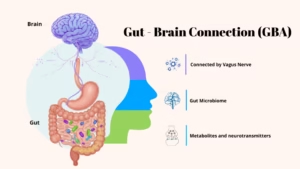
Your gut and brain stay in constant contact through three main channels: the vagus nerve, the immune system, and neurotransmitter signaling [3, 4]. Together, these form a feedback loop—a gut-brain axis that runs both ways. A balanced gut sends signals that support calm and focus; an imbalanced one can send signals that heighten stress.
Gut microbes produce short-chain fatty acids, vitamins, and amino acid building blocks that can directly affect brain activity and hormone regulation [3]. They’re also involved in producing and regulating serotonin, a neurotransmitter tied to mood, appetite, and sleep [5].
The takeaway: the condition of your gut can genuinely influence the condition of your mind.
Psychobiotic Strains: What Makes a Probiotic a Psychobiotic
A true psychobiotic is defined by clinical evidence of its specific effect on the gut-brain axis. That’s why strain-level precision matters—it’s the difference between a general health claim and a documented one:
- Lactobacillus plantarum DR7—studied for its potential to support balanced cortisol levels and healthier stress responses in adults [6].
- Bifidobacterium breve CCFM1025—shown in research to help calm the hypothalamic-pituitary-adrenal (HPA) axis, the body’s core stress-response system [7].
The HPA axis links your brain and adrenal glands, governing how you respond to stress, regulating your sleep-wake cycle, and balancing hormones like cortisol. When it becomes overactive or falls out of rhythm, cortisol can climb — with knock-on effects for mood, stress, and anxiety [8].
The Sleep–Stress–Gut Triangle
Mood and sleep are deeply intertwined. Under stress, the hormones your body releases can throw off your gut microbiome, your mood, and your sleep quality all at once. Psychobiotics that help restore gut balance may, in turn, support steadier sleep and a calmer emotional baseline.
Want to go deeper? Related reading:
- Probiotics and Sleep Quality: What the Gut Has to Do With It
- Can Probiotics Help with Anxiety and Depression? Strains That Support Mood and Mental Health
Where the Science Is Headed
This field is moving fast, and the direction is toward ever more precise, targeted interventions.
Postbiotics—the next frontier. Rather than relying on live bacteria, researchers are exploring purified microbial metabolites—postbiotics—as a more targeted way to deliver gut-brain benefits [9].
Beyond mood: cognition. Scientists are also looking past emotional well-being toward memory and focus. A 2025 review by McCarthy and Martirosyan examined how psychobiotics might support memory and concentration through their effects on the gut-brain axis [10].
The Bottom Line
Psychobiotics offer a science-backed way to approach mental wellness through the lens of gut health — relevant to both everyday consumers and healthcare professionals alike.
Not all probiotics are psychobiotics. When choosing a supplement, look for products with clearly documented strain codes, transparent CFU dosing, and compliance with local guidelines for safety and quality.
Disclaimer: This content is for educational purposes only and is not a substitute for professional medical advice. Consult a qualified healthcare provider before making changes to your diet or health routine.
References
- Dinan, T. G., Stanton, C., & Cryan, J. F. (2013). Psychobiotics: A novel class of psychotropic. Biological Psychiatry, 74(10), 720–726. https://doi.org/10.1016/j.biopsych.2013.05.001
- Ansari, F., Neshat, M., Pourjafar, H., Jafari, S. M., Samakkhah, S. A., & Mirzakhani, E. (2023). The role of probiotics and prebiotics in modulating the gut-brain axis. Frontiers in Nutrition, 10, 1173660. https://doi.org/10.3389/fnut.2023.1173660
- Carabotti, M., Scirocco, A., Maselli, M. A., & Severi, C. (2015). The gut–brain axis: Interactions between enteric microbiota, central and enteric nervous systems. Annals of Gastroenterology, 28(2), 203–209.
- Bravo, J. A., Dinan, T. G., & Cryan, J. F. (2018). The vagus nerve at the interface of the microbiota-gut-brain axis. Frontiers in Neuroscience, 12, 49. https://doi.org/10.3389/fnins.2018.00049
- Bektaş, A., Erdal, H., Ulusoy, M., & Uzbay, I. T. (2020). Does serotonin in the intestines make you happy? The Turkish Journal of Gastroenterology, 31(10), 721–723. https://doi.org/10.5152/tjg.2020.19554
- Chong, H. X., Yusoff, N. A. A., Hor, Y. Y., Lew, L. C., Jaafar, M. H., Choi, S. B., Azlan, A., & Liong, M. T. (2019). Lactobacillus plantarum DR7 improved psychological parameters, cortisol and inflammatory levels in stressed adults: A randomized, double-blind, placebo-controlled study. Clinical Nutrition, 38(5), 2053–2064. https://doi.org/10.1016/j.clnu.2018.09.010
- Lan, Y., Lu, J., Qiao, G., Mao, X., Zhao, J., Wang, G., Tian, P., & Chen, W. (2023). Bifidobacterium breve CCFM1025 improves sleep quality via regulating the activity of the HPA axis: A randomized clinical trial. Nutrients, 15(21), 4700. https://doi.org/10.3390/nu15214700
- Cleveland Clinic. (2024). Hypothalamic-pituitary-adrenal (HPA) axis. Retrieved November 28, 2025, from https://my.clevelandclinic.org/health/body/hypothalamic-pituitary-adrenal-hpa-axis
- Homayouni, A., Houshyar, J., Alikhah, H., Kamalledin Mogadam, S., Osouli, Z., Sarabi-Aghdam, V., & Asghari, A. (2024). Could postbiotics improve mental health? BioSocial Health Journal, 1, 170–172. https://biosocialhealthjournal.com/FullHtml/bshj-32
- McCarthy, J., & Martirosyan, D. (2025). Enhancing cognitive health with psychobiotics. Agriculture and Food Bioactive Compounds, 2(5), 105–119. https://doi.org/10.31989/afbc.v2i5.1651